Climate Impact (GWP)
0.0425
kg CO2-eq/L (Sachet baseline)
Sustainability Research + Communication
This page explains the full project in one place: why we did it, how we calculated impacts, what we found, and what decisions it supports.
Cradle-to-grave comparative LCA with functional unit of 1 L consumed, deterministic + uncertainty outputs, sensitivity scenarios, and policy translation outputs.
Who Is This For?
Climate Impact (GWP)
0.0425
kg CO2-eq/L (Sachet baseline)
Climate Impact (GWP)
0.0897
kg CO2-eq/L (PET baseline)
Water Depletion
12.4 vs 82.6
L of virtual water per 1 L delivered
Cumulative Energy
0.592 vs 1.912
MJ/L (Sachet vs PET)
1. Define
Set goal, audience, functional unit (1 L), and boundaries from raw materials to end-of-life.
2. Collect
Build inventory defaults and uncertainty ranges for packaging, energy, transport, and waste fate.
3. Model
Run deterministic LCA calculations for GWP, water depletion, and cumulative energy demand.
4. Test
Perform sensitivity and Monte Carlo-style uncertainty summaries to test robustness.
5. Translate
Convert outputs into policy and implementation recommendations.
What is included in this study from start to finish.
Foreground + background flows across cradle-to-grave boundary.
| Parameter | Sachet | PET |
|---|---|---|
| Packaging mass per FU | 6 g/L | 24 g/L |
| Filling energy | 0.02 kWh/L | 0.02 kWh/L |
| Transport distance | 40 km | 40 km |
| Recycling share | 5% | 15% |
| Mismanaged/open-burn share | 75% | 50% |
Sachet and PET values per 1 L consumed.
| Scenario | Product | GWP (kg CO2-eq/L) | Interpretation |
|---|
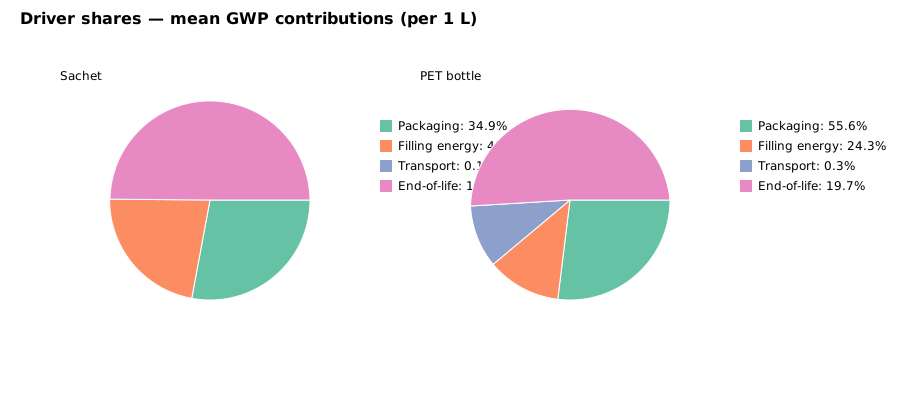
Where impacts are coming from within each life-cycle stage.
Bars show mean values; error bars (95th - 5th range) shown as labels below.
Mean GWP contributions (per 1 L)
Sachet
Packaging: 34.9%
Filling energy: 45.3%
Transport: 0.1%
End-of-life: 19.7%
PET bottle
Packaging: 55.6%
Filling energy: 24.3%
Transport: 0.3%
End-of-life: 19.7%
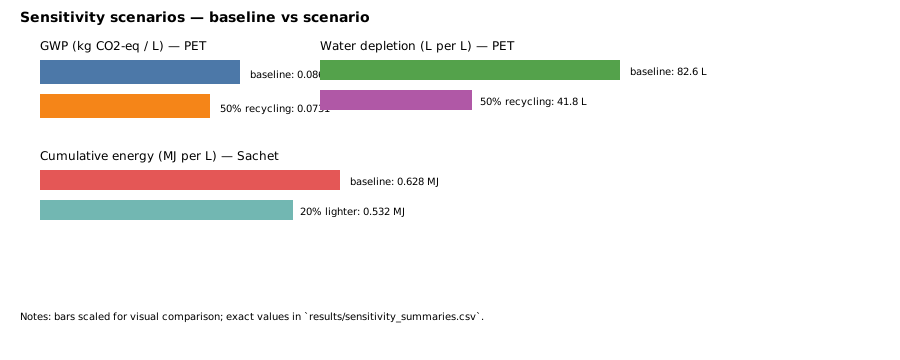
Sensitivity scenarios: baseline vs scenario
GWP (PET baseline vs 50% recycling)
Water depletion (PET baseline vs 50% recycling)
Cumulative energy (Sachet baseline vs 20% lighter)
Move sliders to see what changes policy and design choices can make.
Parametric scenario engine for recycling rate, packaging mass multiplier, and mismanaged sachet share.
15%
100% of baseline
75%
Sachet GWP
0.0000
kg CO2-eq/L
PET GWP
0.0000
kg CO2-eq/L
Sachet water + energy
0.0
(L + MJ) per L
PET water + energy
0.0
(L + MJ) per L
Climate impact is shown separately so low GWP values remain visible.
Climate Impact (GWP)
Water and Energy
Climate Winner
Resource Winner
Best Lever
Use this section as a guided map of the repository for reviewers and collaborators.
Prioritize recycling systems and packaging standards with quantified impact signals.
Identify high-impact levers: lightweighting, recycled content, and end-of-life collection.
Show transparent methods, uncertainty ranges, and actionable outcomes in one narrative.
Translate technical lifecycle results into understandable trade-offs and choices.
| Term | Full Meaning | Simple Explanation |
|---|---|---|
| LCA | Life Cycle Assessment | A method to measure environmental impacts from start to end of a product life. |
| LCI | Life Cycle Inventory | The input data used in an LCA model (materials, energy, transport, waste). |
| LCIA | Life Cycle Impact Assessment | The step converting inventory data into impact indicators. |
| GWP | Global Warming Potential | Climate impact indicator, usually in kg CO2-equivalent. |
| FU | Functional Unit | The common basis of comparison (here: 1 liter consumed). |
| MJ | Megajoule | A unit of energy. |